

What is the coefficient of friction of PVC sofa leather?
Oct 23, 2025
Leave a message
As a PVC sofa leather supplier, I often receive various inquiries from customers. One question that has piqued my interest recently is about the coefficient of friction of PVC sofa leather. In this blog, I'll delve into this topic, exploring what the coefficient of friction means, its significance for PVC sofa leather, and how it impacts the products we offer.
Understanding the Coefficient of Friction
The coefficient of friction is a dimensionless quantity that represents the ratio of the force of friction between two surfaces to the normal force pressing the two surfaces together. It is a measure of how "sticky" or "slippery" a surface is relative to another surface. There are two main types of coefficients of friction: static and kinetic.
The static coefficient of friction (μs) applies when two surfaces are at rest relative to each other and an external force is trying to initiate motion. The kinetic coefficient of friction (μk), on the other hand, comes into play when the two surfaces are already in motion relative to each other. Generally, μs is greater than μk for a given pair of surfaces.
Mathematically, the force of friction (Ff) can be calculated using the following equations:
For static friction: Ff ≤ μsN
For kinetic friction: Ff = μkN
where N is the normal force.
Importance of the Coefficient of Friction for PVC Sofa Leather
In the context of PVC sofa leather, the coefficient of friction plays a crucial role in several aspects.
Comfort
When people sit on a sofa, they expect a certain level of comfort. A sofa with a leather surface that has an appropriate coefficient of friction provides a stable seating experience. If the coefficient of friction is too low, the person sitting on the sofa may slide around easily, which can be uncomfortable and even a bit disconcerting. On the other hand, if the coefficient of friction is too high, it might feel sticky and make it difficult for a person to adjust their sitting position.
Safety
Safety is another important consideration. For example, in a household with children or elderly people, a sofa with a suitable coefficient of friction reduces the risk of accidental slips and falls. When getting up or sitting down on the sofa, a proper level of friction ensures that there is enough grip to prevent sudden movements that could lead to injuries.
Durability
The coefficient of friction also affects the durability of the PVC sofa leather. If the friction is too high, it can cause more wear and tear on the leather surface as it rubs against clothing, skin, or other objects. Over time, this can lead to the degradation of the leather, such as peeling, cracking, or loss of color. A well - balanced coefficient of friction helps to extend the lifespan of the sofa leather.
Factors Affecting the Coefficient of Friction of PVC Sofa Leather
Several factors can influence the coefficient of friction of PVC sofa leather.
Surface Texture
The texture of the PVC leather surface is a significant factor. A smooth surface generally has a lower coefficient of friction compared to a textured surface. Textured PVC sofa leather can provide more grip because the irregularities on the surface increase the contact area and create more points of interaction with other surfaces. For example, a leather with a fine embossed pattern may have a higher coefficient of friction than a completely smooth one.
Surface Treatment
The surface treatment applied to the PVC leather can also affect its coefficient of friction. Some treatments are designed to reduce friction, such as anti - static coatings or lubricating agents. These treatments can make the leather surface feel smoother and more slippery. Conversely, treatments that add a layer of grip, like certain types of finishes, can increase the coefficient of friction.
Environmental Conditions
Environmental factors such as humidity and temperature can impact the coefficient of friction. Higher humidity levels can make the surface of the PVC leather slightly damp, which may increase the friction. Temperature can also affect the physical properties of the PVC material. For instance, at higher temperatures, the PVC may become more pliable, which can change the way it interacts with other surfaces and thus alter the coefficient of friction.
Measuring the Coefficient of Friction of PVC Sofa Leather
To determine the coefficient of friction of PVC sofa leather, specialized testing equipment is used. One common method is the inclined plane test. In this test, a sample of the PVC leather is placed on an inclined plane, and an object is placed on the leather surface. The angle of the inclined plane is gradually increased until the object starts to slide. The coefficient of static friction can then be calculated using the tangent of the angle at which the object begins to move.
Another method is the use of a friction tester, which measures the force required to move a sled or a block across the leather surface at a constant speed. This method can provide more accurate and reproducible results for both static and kinetic coefficients of friction.
Our Offerings and the Coefficient of Friction
As a PVC sofa leather supplier, we understand the importance of the coefficient of friction in our products. We offer a wide range of PVC sofa leather options with different coefficients of friction to meet the diverse needs of our customers.
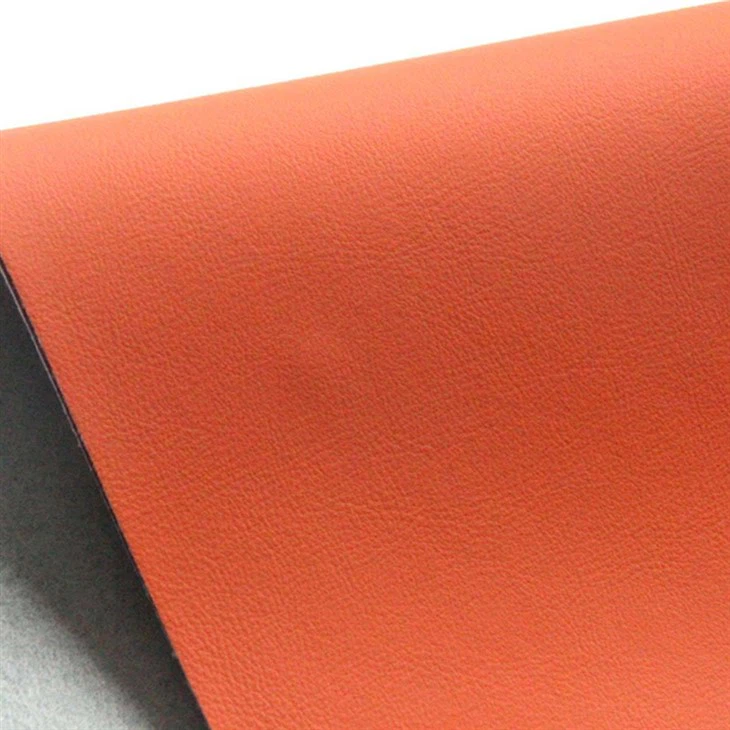

Our PVC Sofa Leather is carefully engineered to have an optimal coefficient of friction. Whether you are looking for a sofa for a residential living room, a commercial lounge, or a hospitality setting, we can provide leather that offers the right balance of comfort, safety, and durability.
For customers who have specific requirements, such as a higher coefficient of friction for a sofa in a high - traffic area or a lower coefficient for a more sleek and modern look, we can customize our products accordingly. We work closely with our customers to understand their needs and ensure that the PVC sofa leather we supply meets their expectations.
In addition to our standard PVC sofa leather, we also offer Cat Scratch Faux Leather. This type of leather is designed to be resistant to cat scratches while still maintaining an appropriate coefficient of friction. It provides a practical solution for pet owners who want a stylish and functional sofa.
We also have PVC Car Seat Leather in our product portfolio. The coefficient of friction of this leather is carefully calibrated to ensure a comfortable and safe seating experience in vehicles. It needs to have enough grip to prevent passengers from sliding around during driving, especially when the vehicle is accelerating, braking, or turning.
Contact Us for Procurement
If you are in the market for high - quality PVC sofa leather, PVC car seat leather, or cat - scratch faux leather, we would love to hear from you. Our team of experts is ready to assist you in selecting the right product with the appropriate coefficient of friction for your specific needs. Whether you are a furniture manufacturer, an interior designer, or an individual looking to upgrade your sofa, we can provide you with the best solutions.
References
- Bowden, F. P., & Tabor, D. (1950). Friction and Lubrication of Solids. Oxford University Press.
- Bhushan, B. (2013). Principles and Applications of Tribology. Wiley.
- ASTM D1894 - 14. (2014). Standard Test Method for Static and Kinetic Coefficients of Friction of Plastic Film and Sheeting. ASTM International.